Surgical Treatment of Hernias on the Anterior Abdominal Wall (inc Paraumbilical, Epigastric) & Incisional Hernias
Surgical options include:
1. Direct repair without mesh – this involves using suturing the defect with nondissolvable sutures eg 1 Nylon, 1 Ethibond.
This is the simplest method.
The main disadvantage is that this technique has a higher risk of recurrence but it can be done for a small hernia defect especially if the patient will not doing heavy lifting and the defect is under 1cm.
Dr Cheah will discuss this option of repair as an alternative to using a mesh if your defect is small.
In the past, a Mayo repair is used – this involves overlapping two layers of tissue and suturing the defect together under tension. Again this has a higher risk of recurrence.
Risks of a recurrence after a sutured repair can be up to 15 to 40% in the literature. (whereas a mesh repair has recurrence rate of 2-5%).
2. Mesh hernioplasty – there are many types of mesh and different techniques - onlay and sublay; open and laparoscopic/robot assited laparoscopic method
TENSION FREE REPAIR WITH Sublay MESH via MINI-INCISION
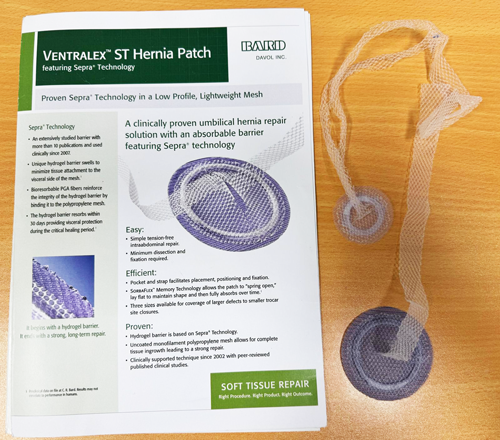
Dr LP Cheah's preference is to use a sublay Ventralex ST mesh using only SHORT SINGLE incision. Usually around 2cm.
No muscle paralysis is needed during the anaesthesia so this can be done under local anaesthesia & sedation too(with laparoscopic surgery "keyhole" - muscle paralysis is needed and 3 incisions need to be made elsewhere - this increases the risk of port site hernias)
This mesh is a dual surface mesh with PTFE(smooth) on one side(the side facing the bowel) and polypropelene on the outside.
This is placed in a sublay position – that is under the hole of the hernia defect within the peritoneal cavity(this is much stronger than in an onlay position). The PTFE surface is in contact with the bowel – because this is smooth there is much reduced risk of developing adhesions of the bowel(adhesions can cause small bowel obstruction). The outside surface is the usual polypropelene mesh – the most commonly used mesh. This mesh allows fibrous tissue to grow it. This mesh is secured by suturing its two polypropelene straps to the edges of the hernia defects without any tension. Additional sutures may be used to approximate the gap. The overlying skin is then closed in layers with dissolvable sutures.
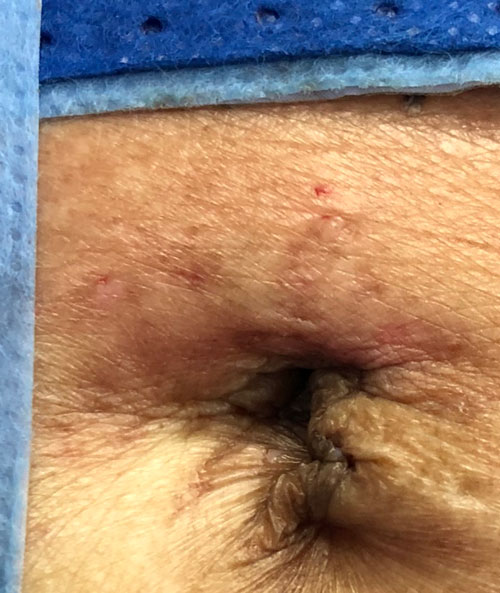
Photo: Repair with sublay Ventralex mesh using a short 2cm incision.
Postoperative Care
1. This surgery is usually carried out as a day case for a small hernia
2. It is important to take regular analgesics as soon as one wakes up from the surgery before feeling any pain(ie before the local anaesthesia wears off)
3. Leave the plastic waterproof dressing on for 2 weeks if possible(there is also often a piece of gauze rolled into a ball under that – this is to push the belly button back in and avoid fluid filling the space of the hernia) . Leave the tape dressings(Steristrips) on for a further 1-2 weeks.
4. Surgical review is at 6 to 8 weeks. If there is any concerns early - the patient can message Dr Cheah on his mobile for Dr Cheah to call back. An earlier review can then be arranged if needed/
When to return to driving ? This varies from person to person – the answer is : Firstly check with your car insurance company. Then only drive when one is comfortable especially to apply the brakes! Please discuss this with your doctor.
Click Here To View The Hernia Recovery Timetable
When to return to work?
Because this mesh is placed in a sublay position(ie the mesh to patch the hole from the hernia is placed on the inside of the hernia defect), there is no strict restrictions to be completely off work.
Dr LP Cheah has had patients returning to work within a few days. For example, the next day for office work. A fruiterer, return to his work within 3 days – lifting dozens of boxes of fruits. Some patients choose to take 2-3 weeks off work.
It really depends on how comfortable ones feel from the cut on the skin and the stitches holding the mesh! Dr LP Cheah tries his best in the surgery to minimize the postop pain by:
1. Using as little tension as possible in suturing
2. Minimizing tissue damage and dissection - being efficient here also means shorter anaesthetic time and less risks
3. Keeping the skin scar short and vertical - the incision is usually just a little longer than a keyhole(hence there is no advantage for laparoscopic surgery here)
4. Ensuring a good local anaesthetic block
When can I play golf again? I would advise to start slowly - with putting and chipping. Then gradually do the drives - do not try to hit a hole in one too soon after the surgery !

Risks of surgery
- Risks of anaesthesia
- Scar
- Pain – rarely complex regional pain syndrome
- Bleeding, bruising, blood clot
- Recurrence – especially from a sutured repair; or a new hernia coming out from above or below the current hernia repair site
- Swelling under scar - less with vertical scar. Sometimes after a repair - the fat under the abdominal skin can bulge in unexpected ways especially if the patient's weight changes after the surgery. Sometimes this can cause a new abdominal crease
- Large hernias - Large hernias carry a greater risk of all complications.
- Morbid obesity - Statistically, patients with higher body mass index have increase the risk of recurrence and other complications leading to increased costs of health care to repair a hernia.
- Mesh - the mesh can become infected and rarely may have to be removed if so. The dual surface of the Ventralex ST mesh is so that the mesh is smooth on the undersurface. This helps reduce the risk of bowel becoming adherent to the mesh on the underside (ST in fact stands for Separation Technology to prevent adhesions with the intestines). However no mesh design is fool proof, bowel can still get stuck to the Ventralex ST mesh especially at the edges (more so in those with increased abdominal wall curvature eg small rectus diastasis). This can potentially cause bowel obstruction or erosion of bowel into the mesh and infection.
- Seroma - this is fluid collecting under the scar of the repair. One option is to leave a drain - but this increases risk of infection. Dr Cheah usually reduces this risk by suturing to close the deep layer of the wounds together so that there is no "dead space" for fluid to build up
- Sutures from mesh repair sticking up to the wound - this can happen in thin patients or where the hernia hole is very close to the overlying skin with little fatty tissue in between. Dr Cheah reduces this risk by using a softer permanent sutures ie 1 Ethibond
- In search engine literature and medicolegal circles - there is Mesh Implant Illness mentioned. This is said to be an Autoimmune or Inflammatory syndrome induced by surgical meshes. Dr Cheah has not seen such a case nor has the physician colleagues he has asked. Symptoms mentioned include chronic fatigue, mucle pain, brain fog. One important thing to mention here is that with the Mini Inciison method Dr Cheah uses to place the Ventralex ST mesh - it is possible to remove the mesh back the same way. Whereas if a mesh was inserted in a laparoscopic fashion or robot assisted laparoscopic fashion - the mesh would be much harder to remove.
- Limitations of hernia repair with Ventralex ST mesh - this hernia repair is suitable for hernias up to a certain size. The mesh sizes are 4.3cm, 6.4cm and 8cm. Ideally there is 2cm rim of mesh around the edge of a hernia defect. Hence a hernia defect more than 4cm would be less suitable for this method alone. Sometimes a hybrid method can be used - whereby sutures are used to reduce the size of the defect and then 1 or 2 meshes placed. Alternatively one can consider a laparosocpic repair or robot assisted repair using a huge mesh.
- Adhesions – rarely bowel obstruction(much less with the dual surface mesh)
- Risk from the mesh – the PTFE and polypropelene material are generally inert. Of course with any foreign material placed within the body, new discoveries may be made in future of potential new side-effects. Future laparoscopic surgery may be more difficult – especially if port has to be place around the belly button area! There might also be increased risks of bleeding and of damaging other organs. If there is infection elsewhere in the body especially in the overlying skin(eg folliculitis) - the mesh can potentially get infected. Hence it is important to see your doctor in future if the umbilicus is red or painful. Sometimes the sutures from the mesh can end up sitting just under the skin especially in a thin person - that can be removed at a later stage once the mesh has incorporated if it is bothering the patient.
Mr LP Cheah is an expert in repairing small hernias on the anterior abdominal wall using short incisions. He has learned his techniques from a number of teachers from Britain, Australia and Canada including Mr Maurice Brygel (Melbourne Hernia Clinic) and Mr David Fossard (England).His Ventralex hernia repair technique has been modified to use shorter incisions without needing any laparoscopic surgery(1 short cut instead of 3, no need for muscle relaxants, no risk of port site hernias)